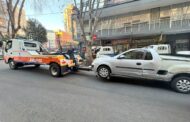

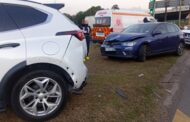
World Cup-related construction works are contributing to an at least 20 percent increase in claims against the Road Accident Fund.
This is according to a company that processes claims.
The organisation is processing roughly 20 percent more claims against the RAF in 2009 than in previous years, primarily due to roadwork-related accidents, CEO of RoadCover Eugene Beck said in a statement.
“Hotspots” include Johannesburg’s Gillooly’s interchange and William Nicol Drive, and the N2 in Cape Town.
More needed to be done to improve safety for drivers and non-motorists at major roadworks, he said.
Poor signage, makeshift concrete barriers, sudden changes in direction of temporary roads and narrower than normal lanes were cited as some of the reasons for accidents at these points.
“Signage at many sites is currently not geared for 24-hour visibility, with night visibility a particular problem.”
There is no policing at these sites where many motorists don’t slow down, or if they do, see it as a chance to use their cellphones, he said. The increase in the number of injuries and deaths at roadworks in South Africa is consistent with the trend in other parts of the world.
According to the latest US statistics by the Federal Highway Administration, the number of people killed annually in motor vehicle crashes in roadwork zones has increased 45 percent over the last 10 years.
“The national roadworks in the run-up to 2010 are necessary in order to improve and elevate our public infrastructure to international standards, but more needs to be done from both a safety and law enforcement perspective in order to protect all road users against accidents,” he said.
An RAF spokesperson was not immediately available to comment. – Sapa
[Story appeared in Sowetan]
View the Arrive Alive road safety website for info on:
• Road Safety near Constructions Zones/ Road Work


2 Comments Received
November 25th, 2009 @1:22 pm
While agreeing that the roadworks and the factors such as unmarked lane changes, narrower lanes etc. may have some effect on the increase in the number of accidents, the blame cannot be laid only at the contractors doors. Most accidents can be avoided in these and other hazardous areas simply by following common sense and sticking to the rules.
This headline says it and one often hears on a news broadcast that “rain caused the accident”, but when the situation is analysed, it should say “The driver’s failure (refusal?)to adjust his/her driving to the weather/traffic/construction conditions caused the accident.” It is the same for the areas with roadworks.
The debacle around efficient licencing means there are many unlicensed drivers on the roads and of those with licences, most should probably at best be called “vehicle operators”, because so few have any real driving skills. The lack of effective policing and prosecution of driving offences is also to blame.
Get the traffic officers out from under the trees, where they sit behind their cameras, and out into the traffic, where they should be. They are after all TRAFFIC officers not photographers. (I have no gripe with the use of cameras to monitor traffic or speed offences, but suggest having a separate division to only man cameras and don’t waste important resuorces like trained traffic officers and patrol/pursuit cars on this, what should be a minor part of traffic policing.)
February 24th, 2010 @8:19 am
Where there are roadworks I diligently follow the reduced speeds.
Normally where the limit is 120 and they want 60 they do it by slowing one to 100 and then 80.
Yesterday on the N1 close to Paarl going towards Cape Town I suddenly saw 60 and had to brake fast.
But I could not recall seeing 100 and 80 before me.
Do they also place cameras at places like this?
If they do how do you defend yourself as one cannot immediately turn around and check if one missed the 100 and 80′s somehow?
Leave A Reply